MED9.X ANTILAG / LAUNCH CONTROL / ASSEMBLER
£159.99
Simplify your life ! Use this software to add antilag or soft launch control on your customers BOSCH MED9 ! Manual or DSG Gearbox! Audi, Bentley, Bugatti, Lamborghini, Porsche, SEAT, Skoda, Volkswagen
Product Benefits
2.0 TFSI Specialist
Purpose-built for VAG 2.0L TFSI engines running Bosch MED9.X ECUs.
Anti-Lag & Launch
Configurable anti-lag with ATDC timing and launch control in one tool.
Manual & DSG
Clutch switch support for both manual and DSG gearbox applications.
Assembler Level
Professional-grade assembler patching for competition and track use.
Product Details
Bosch MED9.X • Anti-Lag • Launch Control • Assembler Patching
MED9.X Antilag & Launch Control — Assembler-Level Binary Patcher for VAG 2.0 TFSI
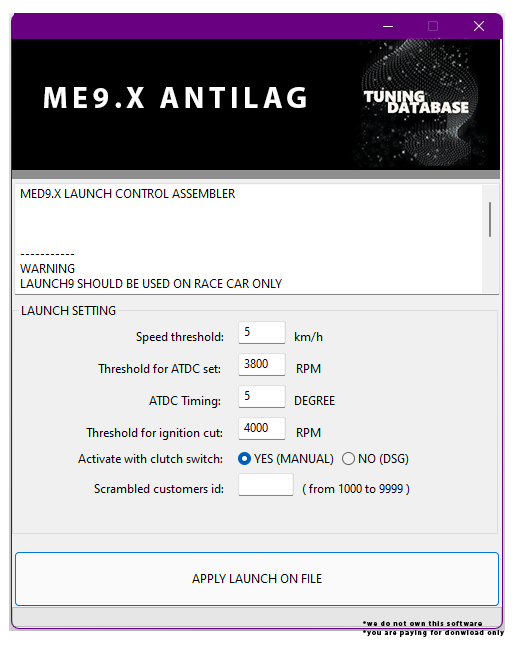
Add anti-lag and launch control to Bosch MED9.X petrol ECUs through direct assembler-level binary patching. Designed specifically for VAG 2.0L TFSI engines. Configurable speed threshold, ATDC timing, ignition cut parameters, and clutch switch support for both manual and DSG gearboxes.
MED9.X
ECU Platform
£159.99
One-Time Purchase
2.0 TFSI
Engine Platform
ASM
Assembler Level
24/7
Support
What Is Anti-Lag & Why Does It Matter?
Originally developed for WRC rally cars, anti-lag keeps the turbocharger spooled when you lift off the throttle — eliminating the delay between throttle input and boost delivery.
The Turbo Lag Problem
Why turbocharged engines lose boost off-throttle
In a turbocharged engine, when you lift off the throttle or change gears, exhaust gas flow drops and the turbocharger slows down. When you get back on the throttle, it takes time for the turbo to spin back up to speed and rebuild boost pressure. This delay is turbo lag — and it means lost acceleration, slower launches, and inconsistent power delivery. On a 2.0 TFSI making 300+ horsepower, that lag can cost you hundreds of milliseconds per gear change and a significant delay from standstill.
Anti-lag solves this by keeping the turbo spinning even when the driver lifts off the throttle. The ECU retards ignition timing and injects extra fuel, which combusts in the exhaust manifold and maintains exhaust gas velocity through the turbine. The turbo stays spooled, boost stays available, and the moment you get back on the throttle, full power is immediate.
Launch Control Explained
Consistent, repeatable launches from standstill
Launch control is a 2-step rev limiter system that holds the engine at a specified RPM while the vehicle is stationary, allowing the turbo to build full boost before the launch. Instead of guessing throttle position and trying to hold a specific RPM manually, the ECU does it for you. Hold the throttle wide open, the ECU limits RPM at your configured launch point while anti-lag builds maximum boost pressure.
Release the clutch (or let the DSG engage) and the full force of the engine is delivered instantly to the wheels. Every launch is consistent. Every launch is at peak boost. This is critical for drag racing, roll racing, and any situation where the first 0.5 seconds determine the outcome. The MED9.X tool configures this directly in the ECU binary via assembler patches.
Configurable Parameters
Four key parameters give you precise control over anti-lag and launch control behaviour. Each is configured through the tool before patching the binary.
Speed Threshold
Vehicle speed activation gate
Defines the maximum vehicle speed at which the anti-lag and launch control system remains active. When the vehicle exceeds this threshold, the system deactivates to prevent unnecessary stress on the powertrain during normal driving.
- Typical Setting: 5–15 km/h for standing launches
- Use Case: Set low for drag launches, higher for rolling anti-lag situations
- Safety: Prevents accidental activation at driving speeds
ATDC Timing
After Top Dead Centre ignition retardation
Controls the amount of ignition retardation applied during anti-lag operation. The ignition event is delayed past top dead centre (ATDC), causing combustion to occur later in the exhaust stroke. This pushes hot exhaust gases through the turbine to keep it spinning.
- Effect: More ATDC retard = more aggressive anti-lag = louder exhaust flame
- Trade-off: Higher values increase exhaust gas temperature and turbo stress
- Tuning Tip: Start conservative and increase until desired boost hold is achieved
Ignition Cut
Configurable ignition cut parameters
Defines the ignition cut behaviour used for the launch control rev limiter. Instead of a smooth fuel reduction, the ECU cuts ignition events to hold the RPM at the configured launch point. This creates a hard, aggressive limiter that builds boost.
- RPM Hold: Engine is held at your configured launch RPM via ignition cut events
- Boost Build: Unburnt fuel reaches the exhaust, ignites, and spins the turbo at the limiter
- Sound: Creates the characteristic burble, pop, and flame at the launch RPM
Clutch Switch
Manual & DSG gearbox support
Configures how the anti-lag and launch control system detects driver intent. The tool supports both manual gearbox (clutch pedal switch) and DSG automatic (gear lever position) activation methods.
- Manual: System activates when clutch pedal is pressed and conditions are met
- DSG: System activates based on gear selector position and brake input
- Automatic Detection: Select your gearbox type and the tool patches accordingly
How It Works: 3 Steps
From stock ECU binary to anti-lag enabled file. Assembler-level patching — no manual hex editing required.
Read Your ECU
Obtain a full binary dump of your Bosch MED9.X ECU using any OBD or bench flash tool (KESS, KTAG, BFlash, CMD, etc.). The tool requires a complete, unmodified binary file from the MED9.X ECU in your 2.0 TFSI vehicle.
Configure & Patch
Open the tool, load your ECU binary, and configure the four parameters: speed threshold, ATDC timing, ignition cut, and clutch switch type. The tool applies assembler-level patches directly to the binary, writing new code routines into the ECU firmware.
Flash & Launch
Write the patched binary back to your ECU using the same flash tool. Anti-lag and launch control are now active. Hold the throttle at standstill, let the boost build, release the clutch and go. Configure, test, and fine-tune parameters as needed.
Assembler-Level Binary Patching
What makes this tool different from map-based tuning — and why it matters for MED9.X.
Unlike simple map-value editing tools that change numbers in existing tables, this tool writes new assembler code directly into the MED9.X binary. Anti-lag and launch control functionality does not exist in the stock MED9.X firmware — there are no maps to edit. The tool identifies free space in the ECU binary, writes new processor instructions (assembler routines) that implement the anti-lag logic, and patches the execution flow to integrate these new routines with the existing engine management code.
New Code Injection
Writes new assembler routines into free binary space. These are real processor instructions, not map value changes. The ECU executes new anti-lag logic as part of its normal engine management cycle.
Execution Flow Patching
The tool modifies the ECU’s program flow to integrate the new anti-lag routines seamlessly. The stock ignition and fuel control logic is extended, not replaced, ensuring safe and stable operation.
Professional Competition Tool
This level of ECU modification is normally only available to professional motorsport teams with dedicated calibration engineers. The tool automates the process while maintaining professional-grade precision.
ECU & Vehicle Compatibility
Designed specifically for the Bosch MED9.X family on VAG 2.0L TFSI engines.
Bosch MED9.X direct injection engine management for the EA113 2.0 TFSI engine
Audi
Audi A3 8P 2.0 TFSI, Audi TT 8J 2.0 TFSI, Audi A4 B7 2.0 TFSI, Audi S3 8P 2.0 TFSI (MED9.1)
Volkswagen
VW Golf Mk5 GTI 2.0 TFSI, VW Golf Mk5 R32/Edition 30, VW Jetta 2.0 TFSI, VW Passat B6 2.0 TFSI, VW Scirocco 2.0 TFSI
SEAT & Skoda
SEAT Leon Mk2 2.0 TFSI (FR / Cupra), SEAT Ibiza Cupra, Skoda Octavia vRS 2.0 TFSI, and other VAG models with 2.0 TFSI MED9.X
Technical Specifications
Everything included with your purchase of the MED9.X Antilag & Launch Control tool.
| Specification | Details |
|---|---|
| ECU Platform | Bosch MED9.X (MED9.1, MED9.1.1, MED9.5, MED9.5.10) |
| Engine | VAG EA113 2.0L TFSI (direct injection turbocharged) |
| Features Included | Anti-Lag System (ALS), Launch Control (2-Step), configurable speed threshold, ATDC timing, ignition cut, clutch switch (manual + DSG) |
| Patching Method | Assembler-level binary patching (new code injection, not map editing) |
| License Model | £159.99 one-time purchase — unlimited vehicles, no subscriptions |
| Operating System | Windows 7, 8, 10 & 11 |
| Gearbox Support | Manual (6-speed) and DSG (S-tronic / DSG7) — configurable via clutch switch parameter |
| Compatible Flashers | KESS, KTAG, BFlash, CMD, and any tool producing full MED9.X binary dumps |
| Vehicle Compatibility | VW, Audi, SEAT, Skoda — all 2.0 TFSI models equipped with MED9.X ECUs |
| Support | 24/7 via email and live chat. Includes documentation and configuration guidance. |
More Professional Tuning Tools
Complete your VAG tuning toolkit with our full range of ECU tools and services.
Add Anti-Lag to Your 2.0 TFSI Today
One-time purchase. Unlimited vehicles. No subscriptions.
Assembler-level anti-lag and launch control for Bosch MED9.X.
✓ £159.99 One-Time
✓ Manual & DSG Support
✓ Unlimited Vehicles
✓ 24/7 Support
Frequently Asked Questions
Everything you need to know about the MED9.X Antilag and Launch Control tool.
What is assembler-level patching and how does it differ from map editing?
Standard ECU tuning modifies values in existing calibration maps (e.g., fuel, boost, ignition tables). Assembler-level patching is fundamentally different — it writes new processor instructions (machine code) directly into the ECU binary. Anti-lag and launch control functionality does not exist in the stock MED9.X firmware, so there are no maps to change. The tool identifies unused binary space, writes new assembler routines that implement the anti-lag logic, and patches the execution flow of the existing engine management code to integrate these new routines. This is the same approach used by professional motorsport calibration teams.
Which MED9.X variants and vehicles are supported?
The tool supports Bosch MED9.X ECUs found in VAG 2.0L TFSI engines (EA113). This includes MED9.1 and MED9.5 variants used in vehicles such as the Audi A3 8P, Audi TT 8J, Audi S3 8P, VW Golf Mk5 GTI, VW Scirocco, SEAT Leon FR and Cupra, and Skoda Octavia vRS — all with the 2.0 TFSI engine. Both manual gearbox and DSG variants are supported via the clutch switch configuration parameter.
Does this work with DSG gearboxes?
Yes. The tool includes a clutch switch configuration parameter that supports both manual and DSG gearbox types. For manual vehicles, the system monitors the clutch pedal switch to detect launch intent. For DSG vehicles, the system uses gear selector position and brake input signals. Select your gearbox type during configuration and the tool patches the appropriate activation logic into the binary.
Is anti-lag safe for the stock turbo and engine?
Anti-lag increases exhaust gas temperatures and places additional thermal load on the turbocharger, exhaust manifold, and catalytic converter. The configurable ATDC timing parameter allows you to control the aggressiveness of the system — lower values are milder and safer for stock hardware, while higher values are more aggressive and suited for upgraded turbo and exhaust setups. We recommend starting with conservative settings and testing on a dyno or in a controlled environment. This product is intended for competition and off-road use. Regular inspection of turbo and exhaust components is advised.
Important: This product is intended for off-road and motorsport competition use. Anti-lag systems increase thermal and mechanical stress on the turbocharger, exhaust manifold, catalytic converter, and engine internals. Always start with conservative parameters and work up gradually. Ensure your cooling system, oil system, and turbo are in good condition before use. If in doubt, contact us before purchase for advice on your specific build.
Related Software
Related: ME7 Anti-Lag Tool | Pops & Bangs Tool | Launch Control Tool | CHKSuite Checksum | View all software
Frequently Asked Questions
Related products
-
-38%
vMax remover ( ECU Speed limiter )
Original price was: £120.00.£75.00Current price is: £75.00. Add to cart -
-50%

KESS V2 Repair kit
Original price was: £50.00.£24.99Current price is: £24.99. Add to cart -
-42%
TunerSuite Ultra — Self-Hosted PHP ECU File Service Portal
Original price was: £1,199.00.£699.00Current price is: £699.00. Add to cart -
INSTATuner AI Software – PREMIUM Full License
£101.99 Add to cart